Joseph John “J. J.” Thomson
Working at the intersection of physics and chemistry, Thomson identified the electron and developed a groundbreaking early atomic model.
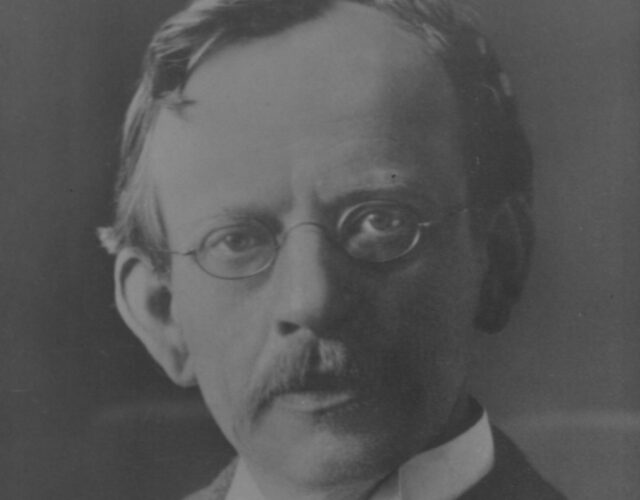
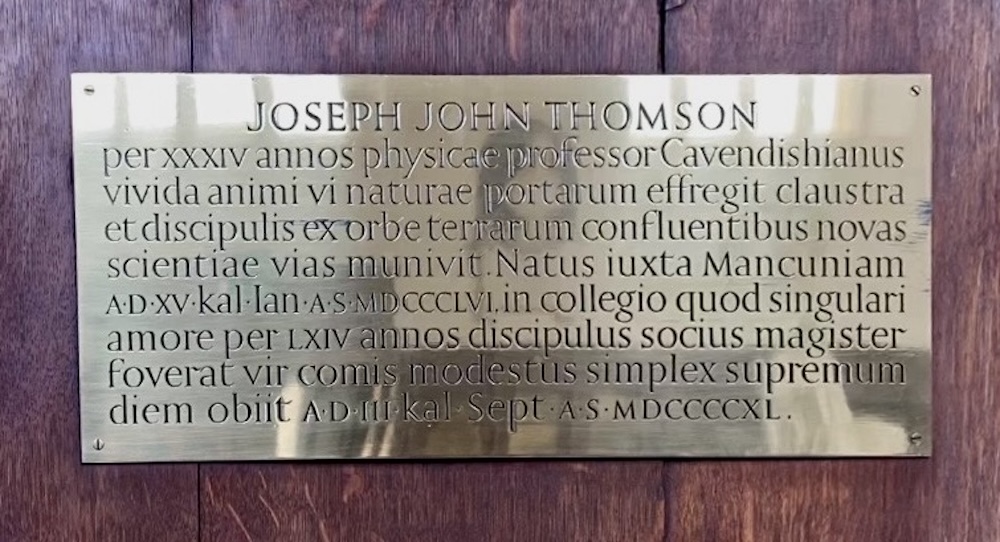
Joseph John “J. J.” Thomson (1856–1940) was an accidental physicist. As he wrote in his memoir, unexpected turns in his life led him to abandon the career path that his parents had identified for him. Despite this, he went on to identify what we know today as the electron, developed one of the earliest atomic models, and found evidence for the first stable isotopes. Although he didn’t realize it at the time, J. J. Thomson’s discoveries opened up a new branch of physics—atomic physics—that has given rise to quantum mechanics, among other specialized fields. The course of Thomson’s career demonstrates that it is okay to deviate from the “expected” life path. His work created new opportunities for physicists who followed in his footsteps.
From Cheetham to Cambridge
J. J. Thomson was born on December 18, 1856, in a suburb of Manchester, England, called Cheetham Hill. He was raised in a middle-class household with his mother, whose family owned a cotton spinning company; his father, whose family operated an antique book shop; and his younger brother. As a child, he was primarily interested in botany and had little exposure to physics and mathematics. His parents expected him to become a locomotive engineer, which was a high-status and well-paid job at the time. But Sharp, Stewart, & Co., the prestigious business where he planned to apprentice, had too long of a waitlist. In the meantime, Thomson’s father decided to send him to Owens College (now the University of Manchester), where he enrolled at the remarkably young age of 14. According to Thomson, this decision was the first key turning point in his life; it was a significant deviation from the career path his family assumed he would follow.
Two years into his time at Owens, Thomson’s father passed away, and his family’s finances began to worsen. Prestigious engineering apprenticeships required a costly fee and provided minimal pay, meaning that one was now financially out of the question. For a moment, Thomson’s future seemed in peril. But he had begun learning about physics, chemistry, and mathematics while at school, which opened a new door to a research career.
One of Thomson’s most influential professors was Professor Thomas Barker, the chair of mathematics. Barker saw great potential in Thomson and convinced him to finish his course of study in engineering. Thomson spent an additional year at Owens studying math and physics, and then he applied for a scholarship at Trinity College, Cambridge. This was the second key turning point in Thomson’s life: he had never planned to pursue an advanced education.
Despite a failed first attempt at Cambridge’s entrance exam, Thomson succeeded on his second try. He entered Cambridge University at age 19 in October 1876, going on to receive several prestigious scholarships that supported his highly theoretical research. In 1880 he completed the Mathematical Tripos, one of the most rigorous math programs in the world, graduating “Second Wrangler” (second in class). Following this momentous achievement, Thomson received a fellowship at Trinity College and settled down to do experimental physics at the renowned Cavendish Laboratory. Upon his graduation, he swiftly received a professorship (1883), a Royal Society Fellowship (1884), and a named chair (1884), a position he held for 34 years.
LEARN MORE
In his autobiography, Thomson wrote of the “large part” the Cavendish Laboratory played in his life. Cavendish was not only significant to Thomson, it has also been central to the history of the physical sciences as a whole. Officially established on June 16, 1874, Cavendish has been a hub of scientific experimentation and thought for 152 years.
Some notable Cavendish researchers in our Scientific Biographies include:
• Florence Ogilvy Bell
• Katharine Burr Blodgett
• Francis Crick
• Ernest Rutherford
• James Watson
Read and compare their stories. Why do you think such communal laboratory spaces are important in the history of science?
Cathode Rays and Corpuscles
J. J. Thomson’s work on cathode rays led him to conclude that atoms are not the smallest unit of matter, reversing centuries of scientific thought. Through experimentation, he discovered particles smaller than atoms, which he called “corpuscles.” It was a claim that caught the attention of Thomson’s fellow scientists.
Think of a cathode ray as a nearly invisible stream of tiny “pellets” that carry electricity. Thomson wondered if these rays would be affected by magnets. When he brought one close to the tube shown below, he observed that the stream started bending by a significant amount. The bending, or “deflection,” that Thomson observed was significantly larger than expected. Thomson was inspired to calculate the charge-to-mass ratio of the cathode ray pellets, which he found to be nearly 1,000 times larger than what would have been expected if the rays had been made up of atoms.
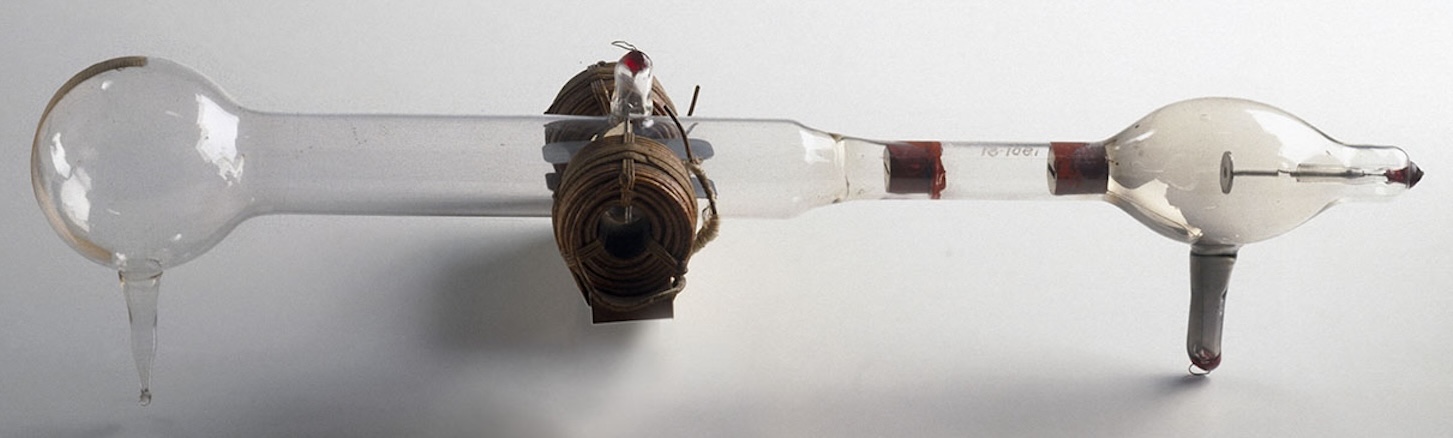
This discovery led him to conclude that the cathode rays must contain “particles small compared with the dimensions of ordinary atoms or molecules.” He called these particles “corpuscles.” Today we call them electrons.
Thomson presented his findings at the Royal Institution of London in April 1897, opening up new subatomic frontiers. With his cathode ray experiments, he unintentionally launched the field of atomic physics, work that earned him the 1906 Nobel Prize in Physics.
Atomic Structure
You might think that the discovery of the electron would be enough for one life’s work. But once Thomson realized that the atom had unexplained components, he knew his research was far from over. Although he had little experimental data on which to base his ideas, he put forth a preliminary model of atomic structure.
In an 1899 paper building on his experimental findings, Thomson described the atom as an uncharged unit of matter made up of smaller particles called “corpuscles” (electrons). In this first model, the corpuscles behave like negative ions and exist in a positively charged space. This early theory laid a good foundation for the concept of the atom, but it needed a lot of work. In 1903, Thomson slightly altered his claim, instead stating that negative corpuscles “revolve” around a positively charged “sphere.”
Thomson’s goal was to present a theory that would motivate new experiments, and he often talked about his work on the structure of the atom as a “rough analogy.” His contributions laid the groundwork for later research on atomic structure and inspired many physicists—notably his own student, Ernest Rutherford—to develop more detailed models of the atom. As Rutherford wrote in 1911, Thomson’s model did not stand up to the weight of experimental evidence, but his theory was useful because it pointed out new lines of research.
Anonymous reports in the leading physics journal, Annalen der Physik, characterized his analogy of the atom in terms of “raisins in a parsimonious plum pudding.” Thomson’s name thus became associated with the “plum pudding model” of the atom, an association that has been repeated through countless lectures and textbooks since the early 1900s. Though it has been surpassed, Thomson’s plum pudding model is still taught to students around the world. It is used as a demonstration of scientific change over time while simultaneously introducing students to the idea of subatomic charged particles in an accessible way.
Later Years and Legacy
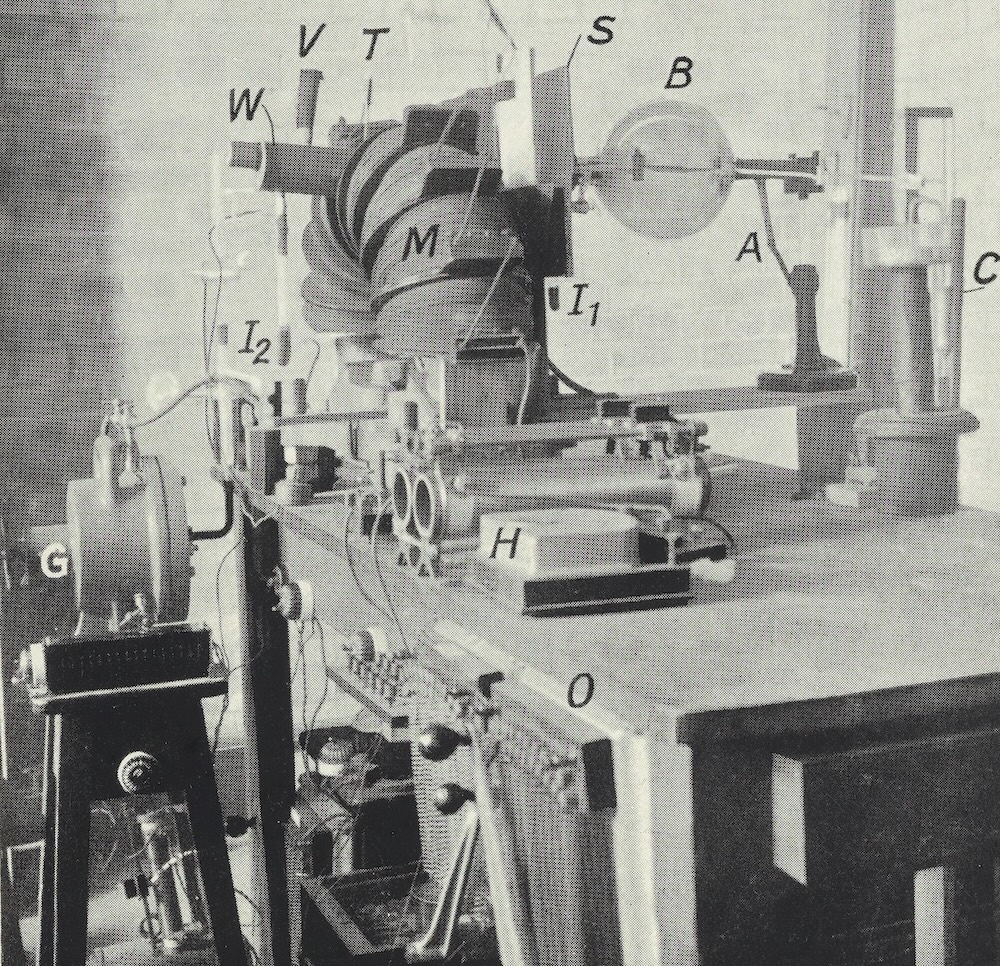
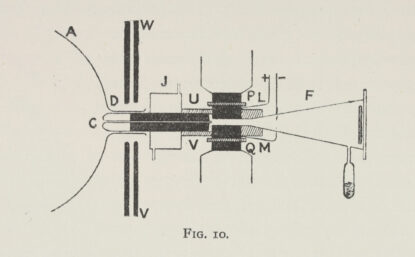
J. J. Thomson never lost his curiosity or his love of learning. After earning the Nobel Prize in 1906, he switched his focus to the subject of positive rays and went on to discover the first stable isotopes. This work led to the development of the mass spectrograph. His assistant, Francis Aston, developed Thomson’s instrument further and used it to discover isotopes in a large number of elements.
Thomson held his Cavendish professorship until 1918, during which time he fostered a powerful community of researchers—sometimes as many as 40 students were conducting research under his leadership at one time. In 1918 he went on to become the Master of Trinity College, leaving Ernest Rutherford to take over his professorship. But Thomson remained active in the Cavendish lab even after he left, publishing 50 more papers before his death in 1940.
Not only was Thomson a remarkable researcher, he was also a formidable teacher and role model. Many of his students went on to make further contributions to science, and seven of them went on to win a Nobel Prize of their own. Thomson was knighted for his contributions to the British Empire by King Edward VII in 1908.
In addition to his academic influence, his family also carried on his legacy. He and Rose Paget married in 1890. A member of the first generation of women to enter advanced university studies, she had been Thomson’s student at the Cavendish. Together they had two children. Their son, George Paget Thomson, was later appointed Professor of Physics at Cambridge and won a Nobel Prize in Physics in 1937.
Hear how Thomson’s early work on the chemical combination of gasses during the 1880s informed his later work on the particles we call electrons today.
Glossary of Terms
Isotope
Isotopes are different versions of a chemical element. They differ from each other only in the number of neutrons they contain, meaning that they vary in terms of mass while other properties remain the same.
Back to top
Cathode ray
This is a stream of negatively charged particles that travel in a vacuum tube from a negative electrical conductor to a positive conductor.
Back to top
Ion
An atom or group of atoms that has an electric charge due to a loss or gain of electrons.
Back to top
Parsimony
Sometimes referred to as “Occam’s razor,” this principle says that when competing theories explain observations equally well, the simplest one is best.
Back to top
Further Reading
A History of the Cavendish Laboratory, 1871–1910.Longmans, Green, & Co., 1910.
Hon, Giora and Bernard R. Goldstein. “J. J. Thomson’s Plum-Pudding Atomic Model: The Making of a Scientific Myth,” Annalen der Physik 525 (2013): A129-A133.
Thomson, Joseph John. “Carriers of Negative Electricity: Nobel Lecture, December 11, 1906.”
Thomson, Joseph John. Recollections and Reflections. London: G. Bell, 1936.
Smith, George E. “J. J. Thomson and the Electron: 1897-1899, An Introduction,” The Chemical Educator 1 (1997): 1-42.
Support
Support for this biography was made possible by the Wyncote Foundation.
You might also like
DISTILLATIONS MAGAZINE
Positive Effect
Meet J. J. Thomson, who disproved Einstein’s dictum that the man “who has not made his great contribution to science before the age of thirty will never do so.”
DIGITAL COLLECTIONS
Atomic Models Over Time
From “rough analogies” to university lectures, the atom has come a long way!
DIGITAL COLLECTIONS
Instruments & Innovation
This digital collection features selected scientific instruments, apparatus, and analytical tools from the Institute’s museum.