Antoine-Laurent Lavoisier
This French chemist introduced the world to hydrogen and oxygen, terms that were at the heart of one of the hottest chemical debates of the 1700s.
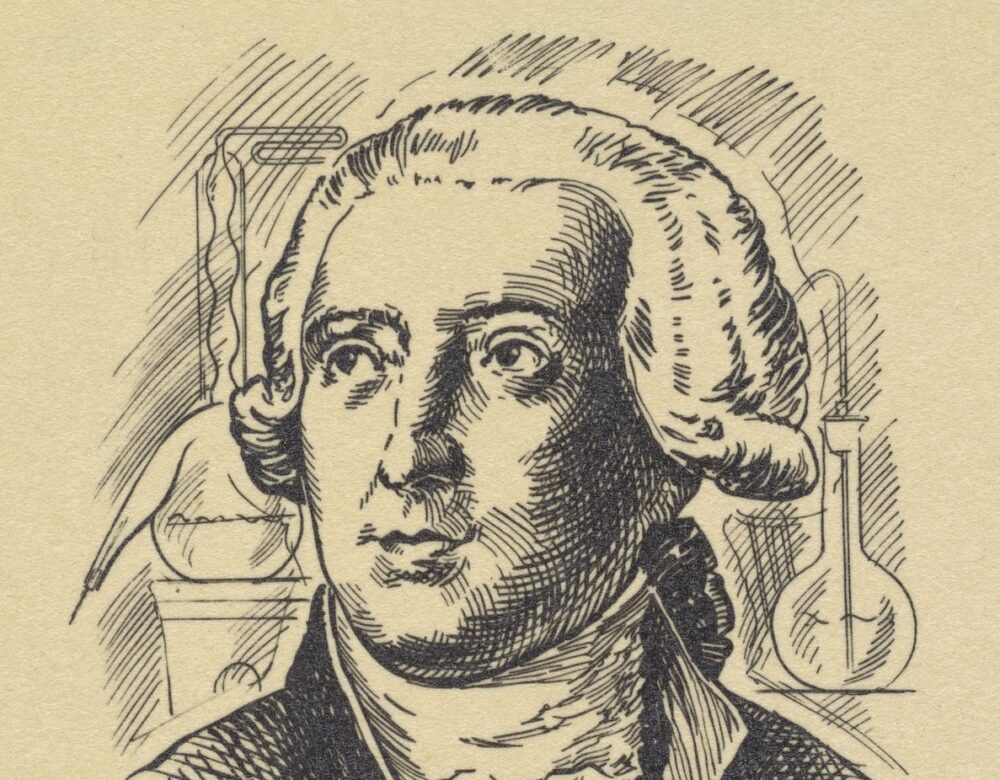
Known as the father of modern chemistry, Antoine Lavoisier (1743–1794) sought to bring order to the field of chemistry. He left a legacy whose echoes can be heard in the words we use to describe our modern elements, as well as in our conception of what an element is. Together with his scientific collaborator and wife Marie-Anne Paulze Lavoisier, he upended the so-called phlogiston theory, establishing that both combustion and respiration required a newly isolated type of air. He named this air “oxygen,” derived from the Greek for “acid former.”
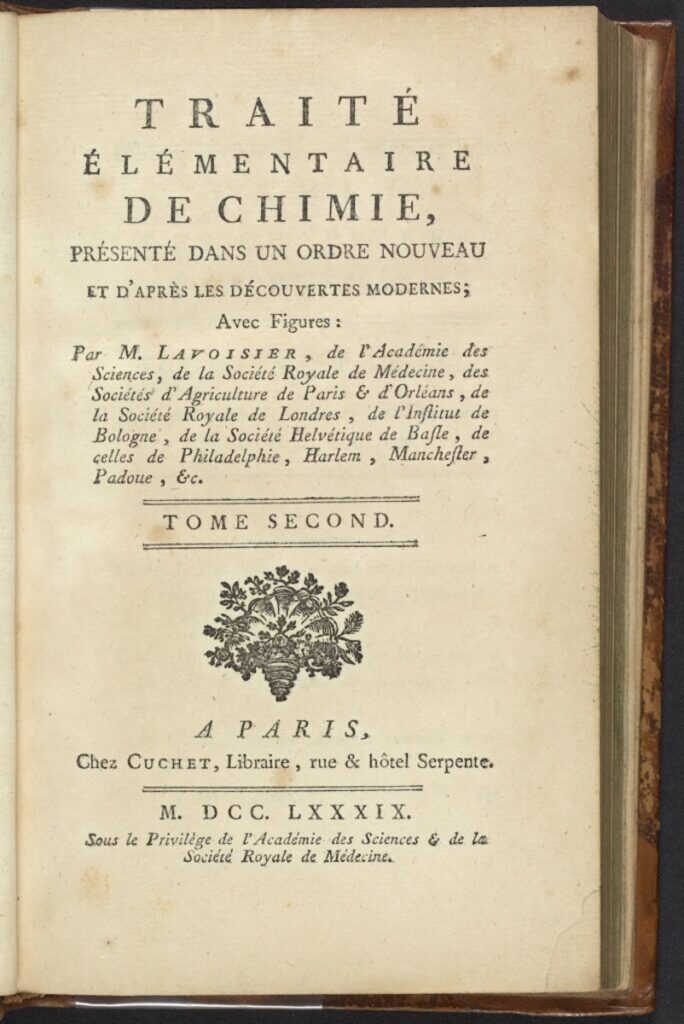
Over the course of a decade, Lavoisier popularized the principle of conservation of mass, demonstrating through experiment that matter can neither be created nor destroyed, only transformed. He proved that water was composed of hydrogen and oxygen—contradicting ancient knowledge of the elements. Drawing on a scientific method that prioritized precise weights and measurements, Lavoisier wrote the definitive textbook of the new chemistry, Traité Élémentaire de Chimie. Against the backdrop of the French Revolution, a political crisis that ushered in fundamental democratic reforms, Lavoisier’s work revolutionized the principles and methods of chemistry.
Early Career
Antoine-Laurent Lavoisier was born in Paris and raised in upper-class comfort, inheriting a large fortune at the age of five when his mother died. He came from a family full of notaries and lawyers, and he was encouraged to pursue a career in the law. He received his legal degree from the prestigious Collège Mazarin in 1763, having already won several prizes in rhetoric. But a career in the law did not interest the young Lavoisier. During his student years, he attended courses in the natural sciences, which captivated his imagination. This was a time when Paris was brimming with enthusiasm for science.
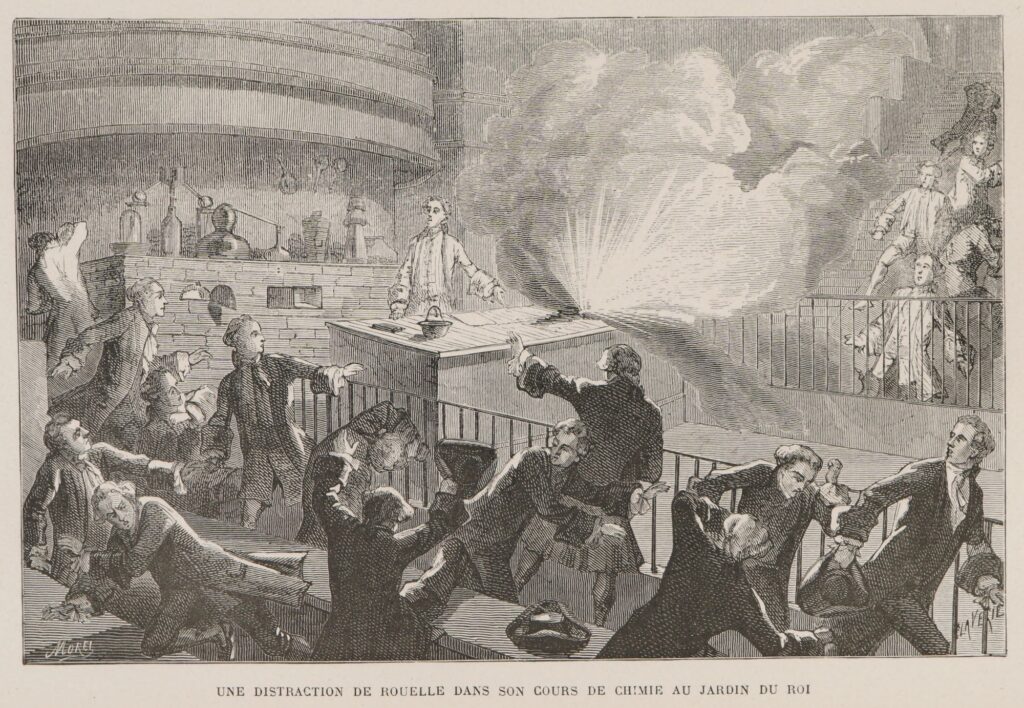
After graduation, Lavoisier traveled the country with his mentor, the geologist Jean-Étienne Guettard, which encouraged his interests in the study of minerals. Following his return to Paris, he attended the public courses given by Guillaume-François Rouelle at the Jardin du Roi. In 1768, Lavoisier was elected to the prestigious Académie des Sciences, becoming one of its youngest members. In the same year, he joined the Ferme Générale, an organization that collected taxes on behalf of the monarchy. This increased Lavoisier’s already vast wealth.
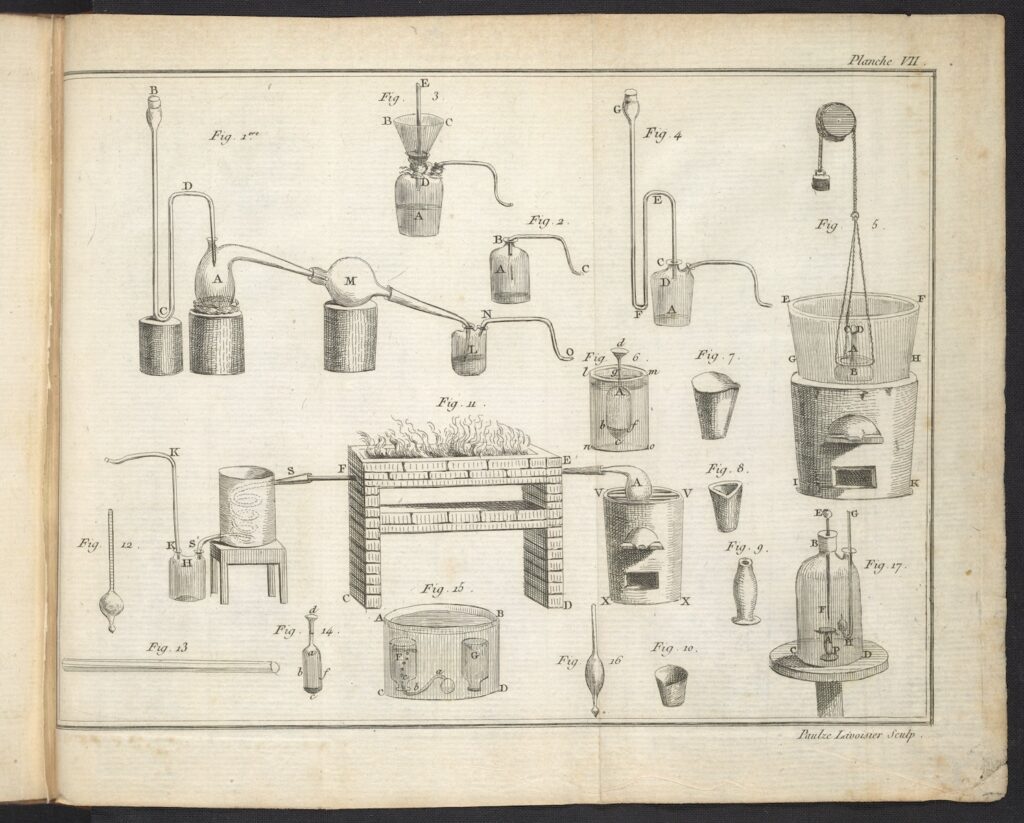
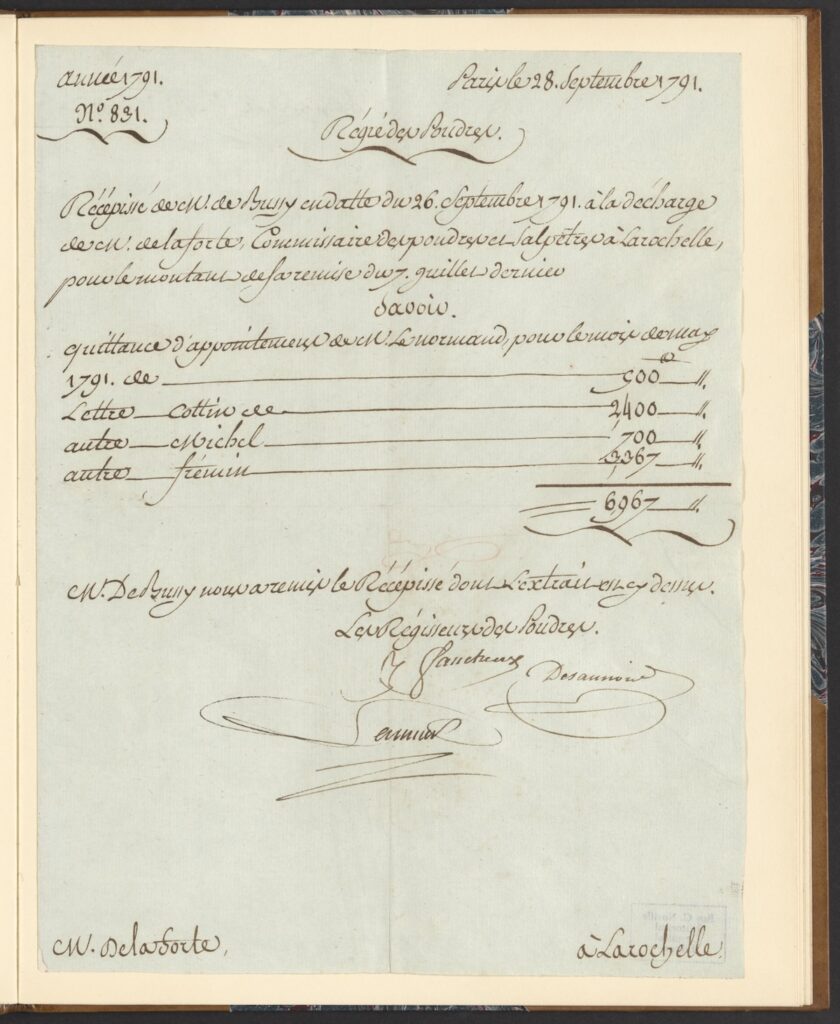
Eighteenth-century chemical labs ran the gamut from collections of common household items such as jam jars, bathtubs, and candles, to elaborate, technologically advanced spaces that looked like factories. Lavoisier’s lab was a prime example of the latter. In 1775, Lavoisier was appointed inspector of royal gunpowder, a job that not only gave him housing, but also a well-equipped laboratory at the Paris Arsenal. There, alongside his wife, he carried out experiments to improve the supply, quality, and granularity of France’s gunpowder.
The Oxygen Revolution
In the 1700s, experimenters began to call the ancient division of elements—air, fire, water, and earth—into question. They discovered that “common air”—the stuff we breathe—could be transformed into an array of different kinds of air. Joseph Priestley among others had observed that both breathing and burning polluted the air, rendering it worse to breathe, while green plants restored its healthy, breathable quality. Phlogiston theory said that combustible things, like charcoal and metal, contained phlogiston. A metal burned in charcoal thus released phlogiston into the air as it burned and became a calx. It followed that heating a calx should take phlogiston out of the air and recreate the original metal. Priestley heated a calx of mercury using a large burning lens. He captured the air created in this experiment, which he called dephlogisticated air. This dephlogisticated, or “vital” air, was especially good for respiration, which Priestley demonstrated by trapping a live mouse within an enclosed jar of it. The mouse thrived, outliving those immersed in common air.
Having heard of Lavoisier’s skill as a chemist, as well as his state-of-the-art laboratory, Priestley traveled to Paris in 1774 and provided his French colleague with a detailed description of how he had isolated this vital air. Lavoisier repeated Priestley’s experiment, but his interpretation turned Priestley’s phlogiston theory on its head. Instead of saying that phlogiston had been absorbed out of the air into the mercury calx when it was heated, the calx instead emitted a particular gas, which Lavoisier named “oxygen.” He called the calx an “oxide”—a name we still use today. His interpretation explained why metals like lead and tin weighed more when they were burned: according to phlogiston theory they should have lost phlogiston, but Lavoisier showed instead that oxygen combined with the metal, increasing its mass.
The New Chemistry
As his analysis of metal oxides shows, Lavoisier’s new chemistry emphasized precise measurements of weight. By carefully weighing all components in a chemical reaction, including the gasses, he argued that one could analyze chemical transformations in accordance with the principle of the conservation of mass. This, in turn, depended on a new definition of what an element was—a substance that cannot be further broken down by chemical analysis. But despite his association with such revolutionary ideas, Lavoisier also retained key pieces of phlogiston theory. For example, he had one foot in an older chemical system of active “principles.” Caloric, or heat, a weightless principle, was among the 33 elements he identified.
Lavoisier developed this new theory more fully in the 1780s after isolating and naming “hydrogen,” from the Greek for “water former.” In some of his experiments with gasses, he noted that water was produced by using a spark to explode various kinds of air. Lavoisier seized on these results and set about reproducing them with his colleague, Pierre-Simon Laplace. Based on this research, Lavoisier and Laplace announced to members of the Académie des Sciences: “water is not a simple substance; it is composed, weight for weight, of inflammable air and vital air.” Through careful measurement and analysis, Lavoisier had shown that oxygen and hydrogen were the component parts of water.
His giving new names to substances—most of which are still used today—was an important means of forwarding the Chemical Revolution, because these terms expressed the theory behind them. In the case of oxygen, from the Greek meaning “acid-former,” Lavoisier expressed his theory that oxygen was the acidifying principle. He considered 33 substances as elements—by his definition, substances that chemical analyses had failed to break down into simpler entities.
Chemical Revolution and Political Revolution
Lavoisier wrote explicitly of his desire to revolutionize chemistry and physics. One year after he published his textbook on chemistry, he founded a new journal, Annales de chimie. While launching this revolution in chemistry, he simultaneously participated in the political revolution then underway. For instance, he was a reform-minded liberal who sat on the Committee of Weights and Measures, which developed the metric system in accordance with French Revolutionary principles. Prior to this work, he had also supported early efforts to draw a map of France, among other activities intended to modernize the nation.
But Lavoisier had also profited enormously from his job as a tax collector in the notorious and unpopular Ferme Générale. It was this involvement—along with his extraordinary wealth—that got him into trouble with the radical wing of the revolutionary movement. Arrested in 1793, Lavoisier was guillotined in the spring of 1794. Upon his death, the mathematician Joseph-Louis Lagrange remarked, “Only a moment to chop off that head and a hundred years may not give us another like it.”
LEARN MORE
Examine these excerpts from Robert Kerr’s translation of Lavoisier’s Elements of Chemistry. In your own words, why was Lavoisier concerned with the characters used to write chemistry? How does this concern relate to the other scientific contributions described in this biography?
Glossary of Terms
Ferme Générale
This was an outsourced indirect tax system that became a symbol of social inequality during the French Revolution. Agents (fermiers généraux) collected money for the monarchy under six-year contracts and took home large bonuses for themselves.
Back to top
Calx
The powdery residue that remains after a metal is burned. Today, we would call this a metal oxide.
Back to top
Further Reading
American Chemical Society. “The Chemical Revolution of Antoine-Laurent Lavoisier.” International Historic Chemical Landmark. June 8, 1999.
Ball, Philip. “Madame Lavoisier’s Translation of Oxygen.” BBC. August 20, 2019.
Guerlac, Henry. Lavoisier—the Crucial Year: The Background and Origin of His First Experiments on Combustion in 1772. Cornell University Press, 1961.
Levere, Trevor H. Transforming Matter: A History of Chemistry from Alchemy to the Buckyball. Johns Hopkins University Press, 2001.
Support
Support for this biography was made possible by the Wyncote Foundation.
You might also like
DISTILLATIONS PODCAST
Ladies Talking to Ladies about Ladies (in Science)
The ‘Lady Science’ magazine editors talk about their new book ‘Forces of Nature: The Women Who Changed Science.’
DISTILLATIONS MAGAZINE
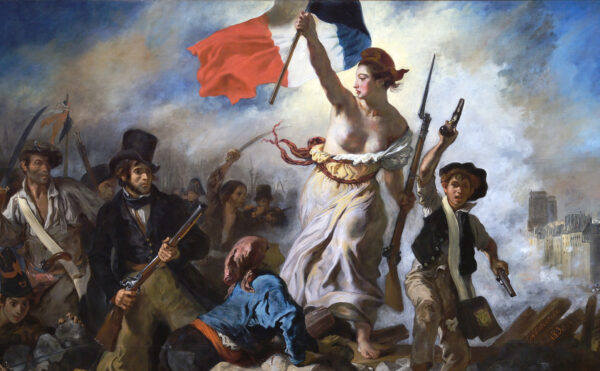
The Trials of Lavoisier
Tracking the Reign of Terror through a revolutionary chemistry journal.
DISTILLATIONS MAGAZINE
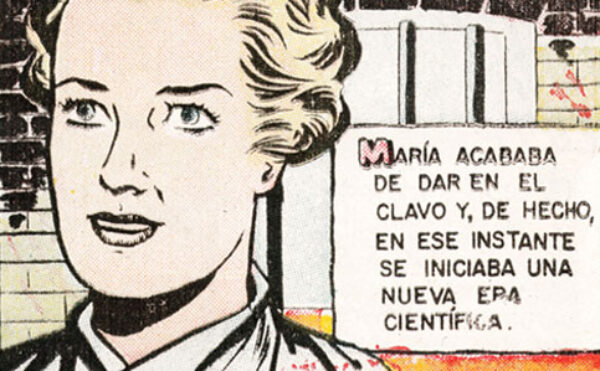
Stories of the Great Chemists
In the 1950s comic books took Mexico’s youth by storm. But alongside familiar superhuman avengers were other kinds of heroes: real-life chemists.