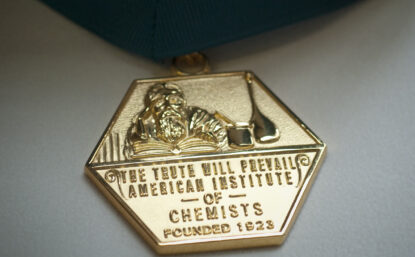
Othmer Gold Medal
The Othmer Gold Medal is the Science History Institute’s preeminent award. Winners are chosen for their extraordinary contributions to the material sciences and are honored each spring.
Founded in 1997, the medal is named after Donald Othmer (1904–1995), a noted researcher, consultant, editor, engineer, inventor, philanthropist, professor, and coeditor of the Kirk-Othmer Encyclopedia of Chemical Technology. The roster of past winners includes some of the most versatile and multitalented individuals in the scientific community.
The Othmer Gold Medal is cosponsored by the American Chemical Society, the American Institute of Chemical Engineers, the Chemists’ Club, and the American Section of the Société de Chimie Industrielle.
2026 Medalist: Sir Cato T. Laurencin
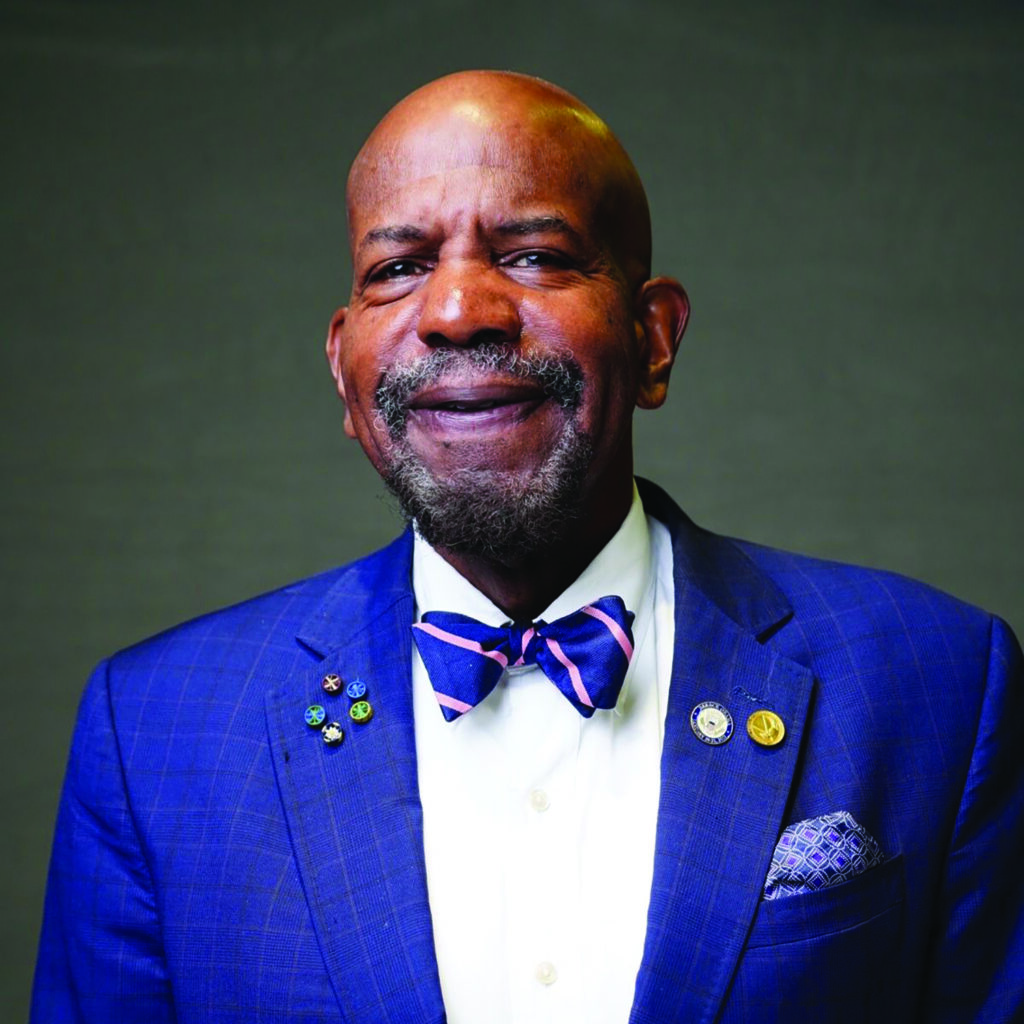
The 2026 Othmer Gold Medal was presented to Sir Cato T. Laurencin at the Institute in Old City Philadelphia on May 6, 2026.
Sir Cato T. Laurencin, MD, PhD, KCSL, SLMH, FREng is one of two university professors at the University of Connecticut. He is a professor of chemical and biomolecular engineering; professor of materials science and engineering; professor of biomedical engineering; and the Albert and Wilda Van Dusen Distinguished Endowed Professor of Orthopaedic Surgery. He serves as chief executive officer of the Cato T. Laurencin Institute for Regenerative Engineering, an institute created and named in his honor. Laurencin is one of the few individuals concurrently elected to the National Academy of Sciences, the National Academy of Engineering, the National Academy of Medicine, the National Academy of Inventors, and the American Academy of Arts and Sciences. He is the first individual to receive both the Walsh McDermott Medal from the National Academy of Medicine and the Simon Ramo Founder’s Award from the National Academy of Engineering.
Laurencin, who pioneered the field of regenerative engineering, is an expert in nanochemistry, biomaterials science, stem cell sciences, and biophysics, and has worked in the convergence of these areas of research. In receiving the Spingarn Medal from the NAACP, he was named as the world’s foremost engineer-physician-scientist. His work spans fundamental basic science involving polymeric materials chemistry all the way to clinical trials and use to treat clinical problems. Laurencin’s versatile use of biomaterials in this area has resulted in an array of products that have improved the human condition. He is the recipient of the National Medal of Technology and Innovation, America’s highest honor for technical achievement, awarded at the White House.
Laurencin is the recipient of some of the highest honors in science, including the Priestley Medal from the American Chemical Society, the Von Hippel Award from the Materials Research Society, the Founders Award from the American Institute of Chemical Engineers, and the Percy Julian Medal from the National Association of Black Chemists and Chemical Engineers. The American Association for the Advancement of Science awarded Laurencin the Philip Hauge Abelson Prize given “for signal contributions to the advancement of science in the United States.” In recognition of his breakthrough achievements in regenerative engineering worldwide, the American Institute of Chemical Engineers created the Cato T. Laurencin Regenerative Engineering Founder’s Award.
Laurencin earned a BSE in chemical engineering from Princeton University, his PhD in biochemical engineering and biotechnology from the Massachusetts Institute of Technology, and his MD, magna cum laude, from Harvard Medical School.
Winners of the Othmer Gold Medal
- R. Graham Cooks (2025)
- Paula Hammond (2024)
- Geraldine Richmond (2023)
- Jay Keasling (2022)
- Dame Carol Robinson (2021)
- Sangeeta Bhatia (2019)
- Joshua Boger (2018)
- Richard Zare (2017)
- Mukesh Ambani (2016)
- Phillip Sharp (2015)
- Kiran Mazumdar-Shaw (2014)
- Harry Gray (2013)
- Marye Anne Fox (2012)
- Kazuo Inamori (2011)
- George Whitesides (2010)
- Ahmed Zewail (2009)
- Yuan Tseh Lee (2008)
- Thomas R. Cech (2007)
- Ronald C. Breslow (2006)
- James D. Watson (2005)
- Jon M. Huntsman (2004)
- George S. Hammond and John D. Baldeschwieler (2003)
- Robert S. Langer (2002)
- Gordon E. Moore (2001)
- Arnold Beckman, Special Millennium Edition (2000)
- Carl Djerassi (2000)
- P. Roy Vagelos (1999)
- Mary Lowe Good (1998)
- Ralph Landau (1997)